Raglan Sleeve: Features and Uses | SHON MOTT
The shape of a sleeve directly influences a garment’s silhouette, movement and relationship with the body. A raglan sleeve is recognised by the diagonal seam that begins under the arm and extends towards the neckline.
Unlike a conventional sleeve, it is not attached to the body through a circular seam around the shoulder. Instead, the sleeve continues up to the neckline and becomes part of the garment’s upper structure.
This change in pattern construction creates a more continuous transition between the torso and the arms. The shoulder appears less defined and the garment takes on a more relaxed presence, although the final result always depends on its volume, fabric and proportions.
What is a raglan sleeve?
A raglan sleeve is a type of sleeve that extends from the underarm to the neckline through a diagonal seam. It can be used in both short- and long-sleeved garments, as well as in fitted or wider silhouettes.
On a conventional T-shirt, the seam follows the shoulder joint and creates a clear visual separation between the body and the sleeve. On a raglan-sleeve T-shirt, the diagonal line produces a more fluid transition.
This construction does not determine the garment’s fit by itself. A raglan sleeve can be part of a close-fitting T-shirt, a relaxed sweatshirt or a more structured coat.
Raglan sleeve: spelling and terminology
In English, the standard term is “raglan sleeve”. In Spanish, the same construction may be described as manga raglán, manga ranglán or, in online searches, manga ranglan without an accent.
These terms do not describe different patterns. They are simply different ways of naming the same sleeve construction.
Main characteristics of a raglan sleeve
Its most recognisable feature is the diagonal seam connecting the underarm to the neckline. This line replaces the traditional shoulder seam and changes the way volume is distributed across the upper part of the garment.
A more continuous shoulder line
Without a seam placed directly at the edge of the shoulder, the upper body appears more fluid. The eye follows the diagonal line from the neckline towards the underarm.
Depending on the angle of the seam and the overall cut, this construction can soften the shoulder line or create a greater sense of width.
Freedom of movement
Raglan sleeves are often associated with functional garments because they organise the space around the shoulder differently.
However, not every raglan-sleeve garment is loose. Its comfort and freedom of movement also depend on the depth of the armhole, the width of the sleeve and the flexibility of the fabric.
A versatile construction
The seam can be straight, curved, subtle or deliberately visible. It can use the same colour as the body of the garment or become a graphic detail through contrast.
This versatility explains why raglan sleeves appear in T-shirts, sweaters, sweatshirts, shirts, jackets, coats and dresses.
Raglan sleeve vs conventional sleeve
A conventional sleeve, also known as a set-in sleeve, is sewn into a curved opening called an armhole. Its upper section follows the shape of the shoulder, creating a clear division between the torso and the arm.
With a raglan sleeve, part of the upper front and back of the garment is incorporated into the sleeve itself. The seam moves towards the neckline, creating a more continuous visual line.
Neither construction is inherently better. A set-in sleeve defines the shoulder more precisely, while a raglan sleeve creates a more fluid relationship between form and movement.
A raglan sleeve should not be confused with a dropped shoulder. In a dropped-shoulder garment, the conventional shoulder seam is simply positioned further down the arm. With a raglan construction, the sleeve extends directly to the neckline.
How a raglan sleeve changes the silhouette
The diagonal seam guides the eye from the neckline towards the underarm, changing how the upper body is perceived.
A wider sleeve with a deeper seam can create a more relaxed silhouette. A clean diagonal positioned closer to the shoulder can maintain a more contained shape.
Colour also plays a role. When the body and sleeves share the same tone, the construction becomes more discreet. When contrasting colours are used, the diagonal seams become more visible and define the torso more clearly.
Common uses of the raglan sleeve
Its ability to adapt to different volumes explains why this construction appears across many types of garments.
Raglan-sleeve T-shirts
The T-shirt is one of its most familiar applications. The construction creates continuity between the neckline and the arm while avoiding a seam placed directly over the edge of the shoulder.
Although raglan sleeves are often associated with two-tone T-shirts, they can also be developed in a single colour for a much more understated result.
Within SHON MOTT’s selection of men’s T-shirts, this construction appears in pieces with clean lines, where the diagonal seam accompanies movement without interrupting the balance of the silhouette.
Sweaters and sweatshirts
In sweaters, the raglan construction allows volume to be distributed from the neckline. This is why it is frequently used in knitted garments and patterns created from the neck down.
In sweatshirts, it supports wider and less rigid shapes. The depth of the armhole determines whether the garment maintains a defined structure or creates more space around the body.
Shirts, jackets and coats
Although less common, raglan sleeves can also be incorporated into shirts. Here, the mobility of the sleeve is combined with more defined elements such as collars, cuffs and button plackets.
In jackets and coats, the construction leaves room for additional layers underneath. It also prevents the seams of several garments from resting on exactly the same point of the shoulder.
Dresses
In a dress, the raglan sleeve softens the transition between the neckline, shoulder and arm. It can be used in both lightweight and more structured garments, with different sleeve lengths and volumes.
Raglan sleeves for women and men
The basic construction remains the same. Differences appear in the proportions of the pattern, the depth of the armhole, the width of the torso and the volume of the sleeves.
A women’s raglan-sleeve T-shirt may feature a more open neckline or a shape that sits closer to the body. Men’s designs often use straighter lines and round necklines.
These are not fixed rules. The adaptability of the raglan sleeve also makes it particularly suitable for gender-neutral designs.
How to recognise a raglan sleeve
The easiest way to identify a raglan sleeve is to observe the path of the seam.
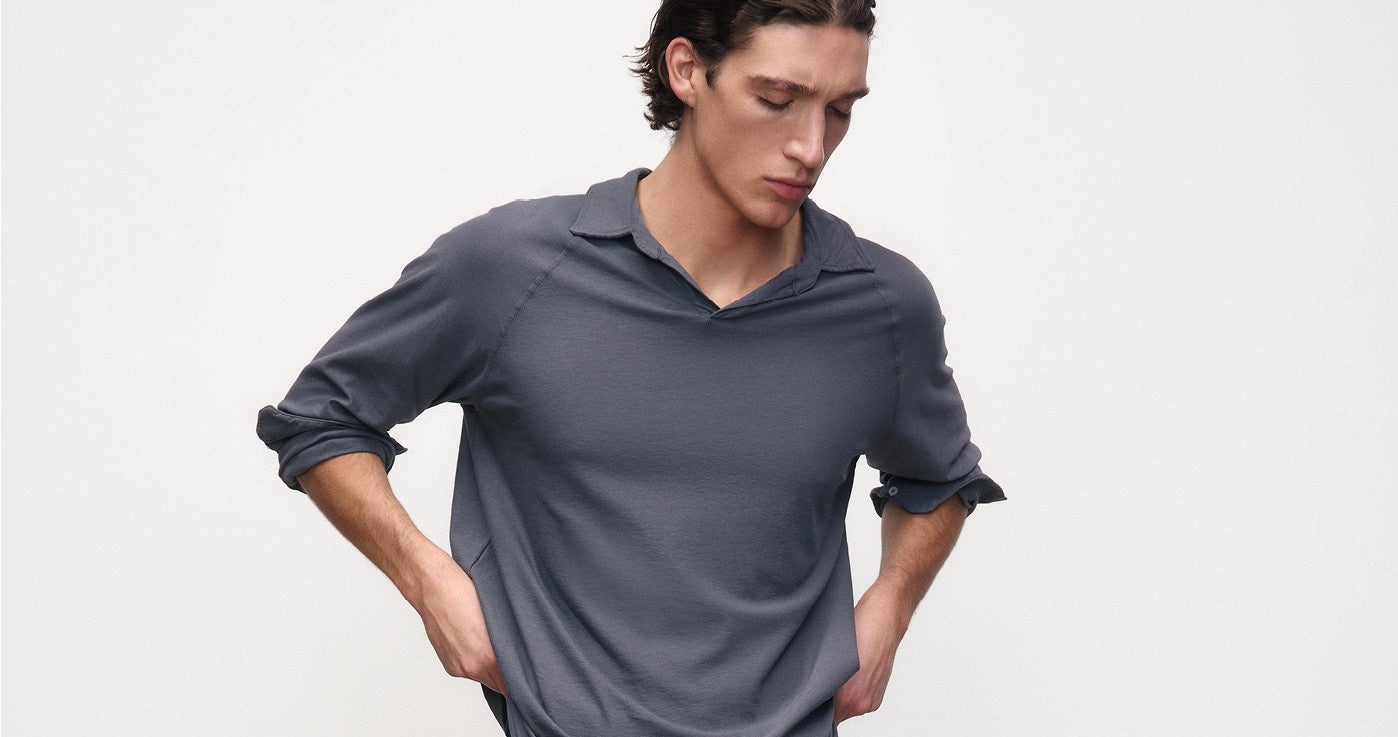
When the seam begins under the arm and travels diagonally towards the neckline, it is a raglan sleeve. When it curves around the shoulder and joins the sleeve to the body, it is a set-in sleeve.
On single-colour garments, the line may initially appear subtle. Following the seam from the neckline reveals how the garment has been constructed.
Frequently asked questions
What is a raglan sleeve?
It is a sleeve that extends from the underarm to the neckline through a diagonal seam, without the circular shoulder seam found on conventional sleeves.
Does a raglan sleeve provide more freedom of movement?
It can support movement by distributing space around the shoulder differently. The final result also depends on the armhole, volume and fabric.
Which garments commonly feature raglan sleeves?
They are commonly used in T-shirts, sweaters, sweatshirts, shirts, jackets, coats and dresses.
Is a raglan sleeve the same as a dropped shoulder?
No. A dropped shoulder keeps the conventional shoulder seam but positions it further down the arm. A raglan sleeve extends directly from the underarm to the neckline.
Are raglan sleeves only used in sportswear?
No. Although they frequently appear in garments associated with movement, they are also used in everyday pieces and designs with a more considered construction.
Can raglan sleeves be used for both women and men?
Yes. The same construction can be adapted through changes in proportion, volume and overall pattern shape.